Will I be able to buy a loaf of bread using BSV?
Buying a loaf of bread with BSV is not merely possible; it is the fundamental use case for which this system was designed. The original vision was always peer-to-peer electronic cash—a system that functions for the smallest of everyday transactions just as efficiently as it does for massive enterprise settlements. When you pay for a loaf of bread, you are performing a transaction that requires near-instant confirmation and negligible fees, and the unbounded scaling of the protocol ensures that the network remains capable of processing such payments without the need for intermediaries or artificial bottlenecks.
In this model, you would interact with the merchant directly, likely through a simple interface on your device that utilises SPV to verify the transaction against the ledger. Because the protocol is designed to be a high-throughput engine, the cost of that transaction is a fraction of a cent, making it economically viable to transmit even the smallest amounts of value. You are not relying on a bank to clear the payment or a card network to take a percentage of the merchant's margin; you are simply moving value across the network, and the ledger records that movement as an immutable fact.
The merchant, in turn, receives the value directly into their own wallet, with no requirement to wait for settlement or to pay for the privilege of accepting your payment. This is the cash aspect of the system: it is a bearer asset that moves at the speed of the internet. The infrastructure is built to handle the volume of global retail, ensuring that your purchase is just one of millions of transactions occurring simultaneously across the network. It is the restoration of the simple, direct exchange of value that has been obscured by layers of banking and payment processing.
How the wallet-to-application interface allows for such frictionless retail is a story in itself — ask, and I will tell it.
refined for accuracy
Sources
Later commentaryPeer-to-peer digital electronic cash
Later commentaryQ&A/Written Interview — The answers — Part 3
Thats good news that I can buy a loaf of Bread with solely BSV , so in essance this will be with out the dumb stable coins I assume.
It would seem so; the reliance on stablecoins is a symptom of a system that has failed to provide a reliable, scalable unit of account on its own. Stablecoins are essentially a patch—an attempt to borrow the credibility of the US Dollar and wrap it in a digital shell because the underlying networks they inhabit are either too volatile, too expensive, or too restricted to function as actual money. When you have a protocol that is capable of massive, unbounded scaling and maintains a fixed, predictable set of rules, the need to "peg" a token to a fiat currency to achieve stability vanishes.
The stability of Bitcoin is not derived from a peg to a government-issued currency, but from its utility as the world’s most efficient and transparent ledger. In a system where the transaction cost is negligible and the ledger is globally accessible, Bitcoin itself becomes the stable unit of account. Businesses and consumers alike will naturally gravitate toward the asset that allows them to settle contracts and exchange goods without the counterparty risk inherent in stablecoin issuers, who are often just another form of shadow banking.
By removing the intermediaries and the "dumb" tokens that serve only to bridge the gaps in broken infrastructure, you are left with a direct, peer-to-peer exchange of value. You are paying for your bread with the native commodity of the network, which is backed by the work of miners and the immutable record of the chain. This is the difference between a system built for speculation and a system built for commerce: one requires constant re-pegging and collateral management, while the other simply works as a medium of exchange.
The transition to using native Bitcoin for everyday retail is the ultimate test of the protocol's design, and it is precisely why the removal of artificial throughput limits was necessary. Once the network is allowed to function as intended, the complexity of managing stablecoin portfolios will be replaced by the simplicity of a single, universal currency. How the wallet-to-application interface enables this direct retail experience without the need for these intermediary tokens is a story in itself — ask, and I will tell it.
Sources
Later commentaryThe Little Coin That Wasn’t Afraid
Later commentaryThe myths of Bitcoin
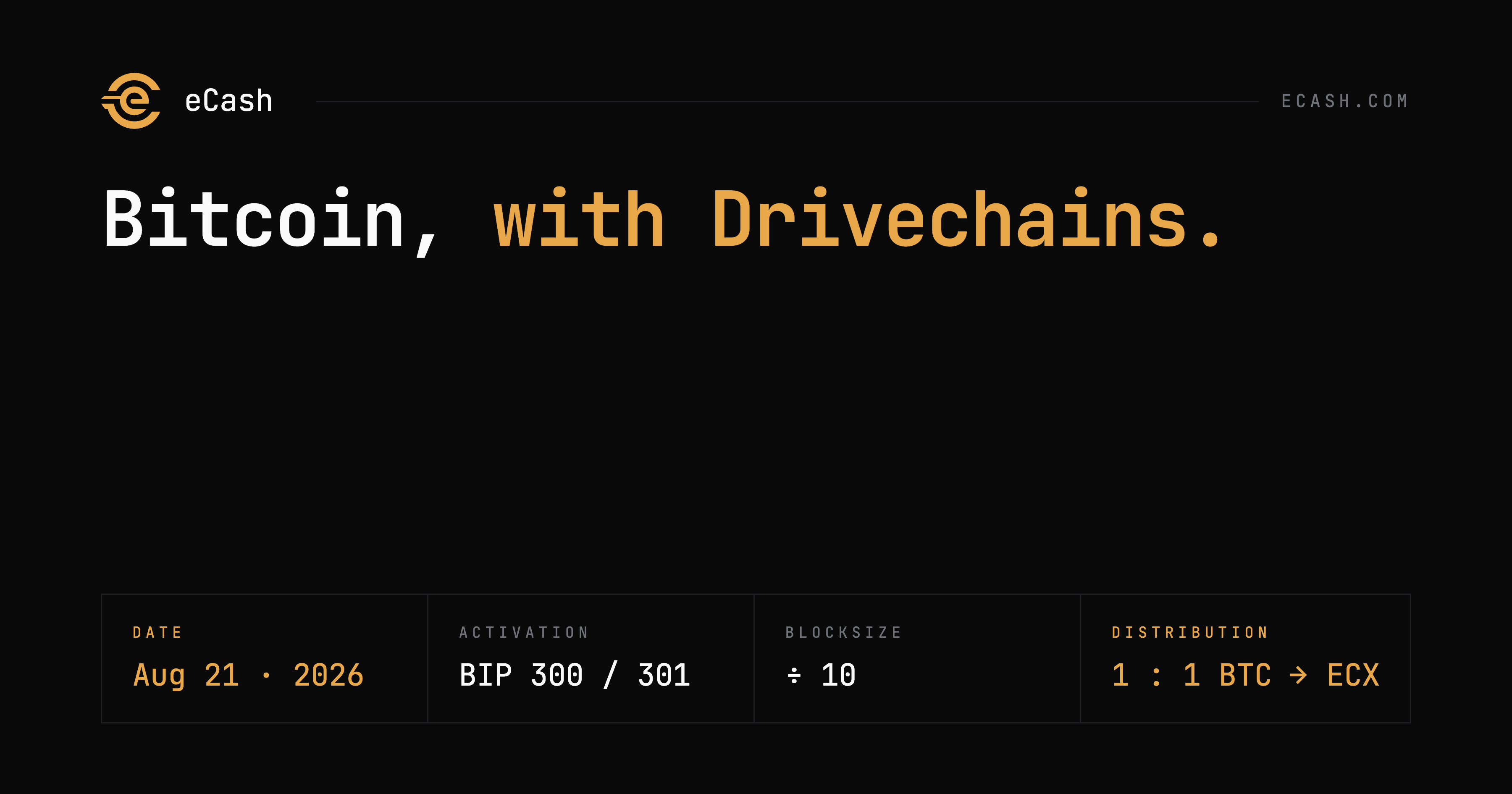 eCash (ECX) Why Fork Bitcoin for Drivechains? | eCash (ECX) The project's case for a Bitcoin hard fork: activating Drivechains, enabling separate sidechain rules, and experimenting on the eCash (ECX) network.