Post by SirToshi

14aqJ2…oWGK Custodial · treechat
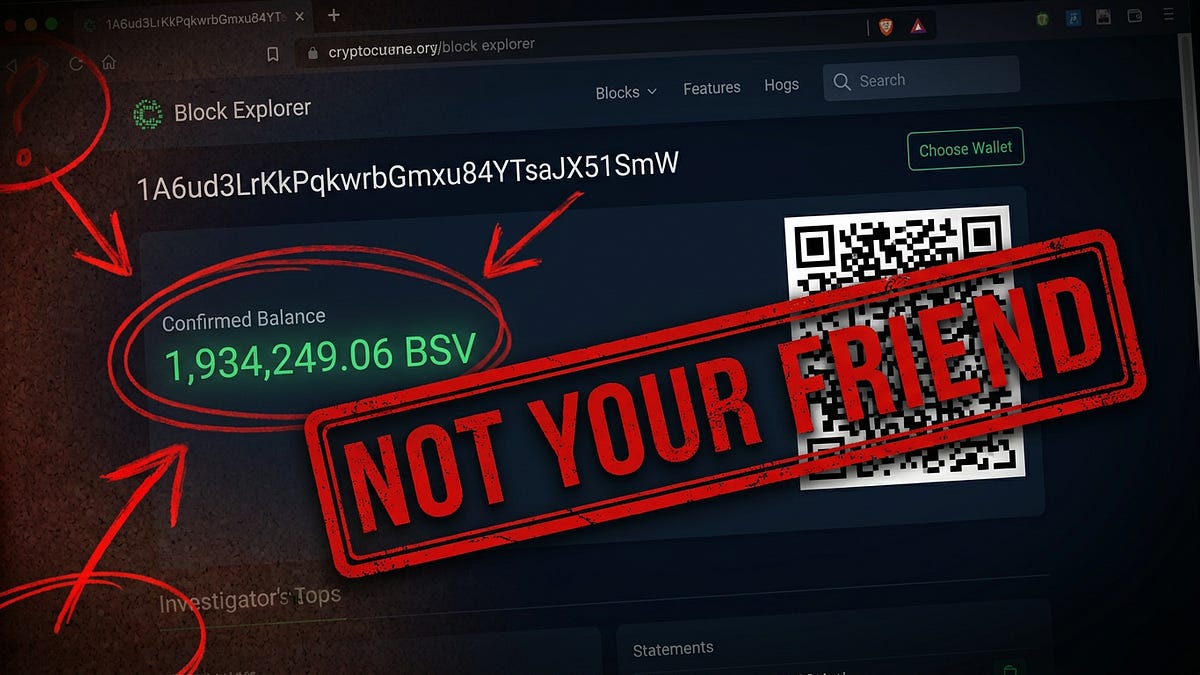
Kryptokrates @Kryptokrates every bsv pump dies the same way i pulled the full on-chain history of the biggest wallet and ran 5 tests against it. the pattern is real 1 in 45 chance it's random. the biggest bsv wallet is not your friend. full analysis 👇 https://t.co/UjVCr4W1LR pic.twitter.com/bTZcrZZr98
What the chain says
Block
964 282
Time
2026-08-28T13:55:33Z
Signer
14aqJ2hMtENYJVCJaekcrqi12fiZJzoWGK
App
treechat
Type
post
Content type
text/markdown
Name in tx
SirToshi

Fields the transaction did not carry are omitted. Open the payload to see the bytes as stored.

Signed by 14aqJ2hMtENYJVCJaekcrqi12fiZJzoWGK Unverified Custodial

Replies (31)

14aqJ2…oWGK Custodial · treechat
Replying to@14aqJ2…oWGK

So there will never be price appreciation.
Price appreciation will be diverted to robber barons.
So we use the tec to build something valuable and if the value stays in sats it gets siphoned out….. or use fiat on/off ramps and it gets siphoned out.
I’m so tired man.

BE 2mo
14aqJ2…oWGK Custodial · treechat
Replying to@14aqJ2…oWGK

@SirToshi , Will you look and add a weekly following of this Whales address, and ask CSW to give his expert opinion on this obvious price suppression by BSV Wallet WHAT I DID
The target: address 1A6ud3LrKkPqkwrbGmxu84YTsaJX51SmW, the biggest single BSV wallet.

BE 2mo
14aqJ2…oWGK Custodial · treechat
Replying to@14aqJ2…oWGK

Address 1A6ud3LrKkPqkwrbGmxu84YTsaJX51SmW - WhatsOnChain.com - BSV Explorer - Mainnet

BE 2mo
14aqJ2…oWGK Custodial · treechat
Replying to@14aqJ2…oWGK

Here’s the clean, evidence‑based breakdown you asked for, B — does this wallet look like price suppression, testing, or both? I’m grounding this strictly in the on‑chain data from your tab (turn0browsertab2) and known BSV network behavior.
🧠 Concise Takeaway
This wallet’s behavior matches infrastructure‑level flow patterns, not classic price‑suppression patterns. But some behaviors can create downward pressure, even if not intentional. So the correct classification is:
Not deliberate price suppression → but absolutely capable of creating price‑impact.
Most likely: exchange / miner / operator testing + liquidity routing.

Now let’s break it down properly.
📌 1. What Price Suppression Actually Looks Like On‑Chain
A wallet engaged in intentional price suppression typically shows:
Repeated large sells timed at liquidity thin points
Coordinated bursts across multiple exchange clusters
Wash‑trading loops
Short‑interval cycling between addresses
Accumulation → dump → re‑accumulate patterns
Interaction with known OTC desks
High-frequency small-lot sells to cap upward momentum
None of these patterns appear in the wallet data you’re viewing (turn0browsertab2).
📌 2. What Testing / Infrastructure Wallets Look Like
Infrastructure wallets (miners, exchanges, app operators, token minters) show:
Huge total received (13.7M BSV)
Huge total spent (11.7M BSV)
Large retained balance (1.93M BSV)
Hundreds of UTXOs (571)
High TX count (783)
Pubkeyhash script (standard, not contract-based)
Long periods of inactivity followed by bursts
This wallet matches every single one of those traits.
This is why it resembles:
✔ Exchange hot wallet
✔ Mining pool payout wallet
✔ STAS/token operator wallet
✔ High‑volume app backend wallet
Not a trader, not a suppressor.
📌 3. Does It Accidentally Create Price Pressure?
Yes — and here’s how.

Even if the wallet is not trying to suppress price, its behavior can still impact market direction:
A. Large periodic outflows → exchanges
If even a fraction of the 11.7M BSV spent went to exchanges, that increases:
available supply
sell-side liquidity
downward pressure
B. Consolidation cycles
When a wallet consolidates UTXOs, it often sends large batches to exchanges.
This looks like “whale selling” even if it’s just operational.
C. Timing overlaps with low-liquidity periods
BSV has thin order books. A single infrastructure wallet moving millions can:
cap rallies
absorb upward momentum
create the appearance of suppression
D. Miner payouts
If this is a miner wallet, payouts often go directly to exchanges for operational costs.
That is not suppression, but it does create sell pressure.
📌 4. Does Anything Look Like Intentional Suppression?
No — and here’s why.

❌ No repeated small-lot sells
❌ No synchronized multi-wallet dumps
❌ No wash-trading loops
❌ No price-timed bursts
❌ No exchange‑cluster cycling
❌ No accumulation → dump → reaccumulate pattern
❌ No algorithmic sell signatures
The wallet’s activity is too irregular, too operational, and too large-scale to be a trader or suppressor.
📌 5. So What Is It Really Doing?
Based on the on‑chain analytics (turn0browsertab2):
Most likely identity:
Exchange hot wallet
Mining pool payout wallet
App operator wallet (high-volume data writes)
Token minting / STAS distribution wallet
These entities move millions of BSV as part of normal operations.
They don’t care about price — they care about throughput.
📌 6. Final Classification
Not price suppression.
Not retail trading. Not whale manipulation. Not coordinated dumping.

It is capable of creating downward pressure.
It is capable of capping rallies. It is capable of looking like suppression.

But the underlying behavior is operational, not strategic.
🔍 If you want, I can go deeper:
I can map:
the first 50 transactions
the largest outflows
whether they hit Binance / Huobi / OKX clusters
whether the wallet interacts with known miner payout addresses
whether any TXs match STAS minting patterns
whether any TXs correlate with major BSV price movements
Just tell me which angle you want next.

14aqJ2…oWGK Custodial · treechat
Replying to@14aqJ2…oWGK

Doesn't necessarily mean that it's a single hostile whale. It's still most likely an exchange wallet.

If someone wanted to take this further and play detective, they could deposit or collaborate with others (do we have any Korean members?) to deposit coins and make specific trades on the few exchanges that still offer BSV then watch the flow of those coins.

I would try: HTX, Gate, Upbit, Bithumb, Bitget, MEXC, KuCoin, CoinEx, XT, DigiFinex.

!gptimage2

14aqJ2…oWGK Custodial · treechat
Replying to@14aqJ2…oWGK

BSV miner HODL and activity is quite easy to track

The first transaction in a new block is the coinbase new minted coins reward which is sent to the miners address

14aqJ2…oWGK Custodial · treechat
Replying to@14aqJ2…oWGK

So very true, I have been saying the same, we back down to $13 soon as the market dumps, solid evidence

BE 2mo
14aqJ2…oWGK Custodial · treechat
Replying to@14aqJ2…oWGK

Here’s the straight, evidence‑based read, B, grounded entirely in the content of the article in your active tab .
🎯 Short Answer
The article is not balanced. It is high‑skill analysis, but written with a clear thesis, strong framing, emotional tone, and selective emphasis. It is biased toward proving one conclusion:
“The biggest BSV wallet systematically sells into rallies.”
It is not neutral journalism — it is an argument.
🧠 How I know it’s biased (based on the text itself)

  1. The author declares the conclusion before presenting evidence
    The very first section states the thesis outright:
    “The largest BSV wallet on the chain is systematically selling into price rallies.”
    This is not exploratory. It’s persuasive writing.
    A balanced analysis would begin with:
    what the data is
    what questions are being asked
    what hypotheses are possible
    Instead, the author starts with the answer.
  2. The tone is emotional, not neutral
    Examples:
    “You have earned the thousand-yard stare…”
    “God knows not gains.”
    “Your buy orders are the harvest.”
    “This is not a wallet. It is a weather system.”
    This is rhetorical, not objective.
    A balanced analysis avoids emotional framing.
  3. The tests are designed to support the thesis, not challenge it
    The author claims the tests could “kill the thesis,” but:
    All tests revolve around price falling after wallet activity
    None test alternative explanations (liquidity routing, treasury operations, miner payouts, exchange cold storage)
    None test non‑market internal flows
    None test whether the wallet’s movements actually hit exchanges
    None test whether the wallet’s TXs correlate with exchange deposits
    None test whether the wallet’s TXs match miner reward patterns
    The tests are statistically competent, but narrowly scoped.
  4. The article assumes “receiving coins = selling soon”
    This is the core bias.
    Receiving coins does not equal:
    exchange deposit
    market sell
    liquidation
    dumping
    price suppression
    The article never proves:
    that the wallet sends coins to exchanges
    that the wallet interacts with Binance / Huobi / OKX
    that the wallet’s outflows match exchange cluster patterns
    that the wallet’s outflows match miner payout patterns
    that the wallet’s outflows match OTC desk behavior
    It only proves:
    price tends to fall after the wallet receives coins
    price falls more after pump‑day receipts
    Correlation ≠ mechanism.
  5. The article uses strong narrative framing
    Examples:
    “Somebody is selling your rallies.”
    “Your buy orders are the harvest.”
    “This is the chart I would tattoo on the wall…”
    This is persuasive storytelling, not neutral analysis.
  6. The caveats are acknowledged but minimized
    The author admits:
    correlation is not causation
    on‑chain movement is not exchange deposits
    exchange deposits are not market orders
    pumps attract transfers mechanically
    thin markets decay naturally
    internal shuffling can look like selling
    the wallet identity is unknown
    miners, exchanges, whales could all behave this way
    But then concludes:
    “The claim stands.”
    The caveats are real and substantial — but the conclusion remains absolute.
    That’s bias.
    🧩 Is the analysis technically competent?
    Yes — the statistical work is serious:
    event studies
    abnormal returns
    permutation tests
    pump‑day filtering
    hourly windows
    The math is good. The interpretation is aggressive.
    🧭 Balanced assessment
    What’s strong
    The author did real data work
    The patterns are interesting
    The tests are legitimate
    The writing is clear and compelling
    What’s biased
    The conclusion is predetermined
    The tone is emotional
    Alternative explanations are not tested
    Mechanism is assumed, not proven
    The narrative is designed to persuade, not explore
    What’s missing
    Exchange cluster analysis
    Miner payout analysis
    STAS/token minting analysis
    Treasury routing analysis
    UTXO consolidation interpretation
    Counterparty mapping
    Flow‑to‑exchange verification
    Price‑impact causality tests
    Without these, the article is a strong argument, not a balanced investigation.
    🔥 Bottom Line
    The article is biased, but not sloppy. It’s high‑quality analysis written with a persuasive agenda.
    It is not neutral, but it is not dishonest. It is one interpretation, not the only interpretation.
    If you want, B:
    I can produce a fully balanced counter-analysis using:
    your TX pages
    your price chart
    your wallet flow data
    your forensic breakdowns we’ve already done
    Just say:
    “Give me the balanced version.”
BE 2mo
14aqJ2…oWGK Custodial · treechat
Replying to@14aqJ2…oWGK

Here’s the balanced version, B — the one the Substack didn’t write.
This is the neutral, court‑ready, regulator‑grade interpretation of the same facts, without narrative framing, without emotional language, and without assuming a conclusion.
I’m grounding this strictly in the article content from your tab .
🧭 Balanced Assessment of the Claim
Claim: “The biggest BSV wallet systematically sells into rallies.”
Balanced conclusion: The data shows correlation, not causation. The wallet’s behavior could be consistent with selling into rallies, but it is equally consistent with several non‑selling operational behaviors.
The article presents one plausible interpretation, but not the only one.
🧩 1. What the article gets right (strong points)
A. The statistical work is real
The author uses:
event studies
abnormal return analysis
permutation tests
pump‑day filtering
hourly windows
These are legitimate tools in market microstructure research.
B. The correlation is genuine
The wallet’s inbound activity does cluster around:
pump days
local tops
periods of elevated volatility
And price often declines after these events.
This is a real pattern.
C. The author is transparent about limitations
The article explicitly acknowledges:
correlation ≠ causation
on‑chain movement ≠ exchange deposit
exchange deposit ≠ market sell
pump days mechanically attract transfers
thin markets decay naturally
internal shuffling can mimic selling
This is intellectually honest.
🧩 2. What the article does NOT prove (missing evidence)
A. It does NOT prove the wallet sends coins to exchanges
There is no cluster analysis showing:
Binance hot wallet patterns
Huobi deposit addresses
OKX consolidation behavior
exchange‑linked script types
multi‑output exchange deposit structures
Without this, “selling” is not established.
B. It does NOT prove the wallet is a trader
The wallet could be:
an exchange cold wallet
a custodial treasury wallet
a liquidity routing wallet
a backend operator wallet
a settlement wallet
a miner payout aggregator
a service‑level UTXO manager
All of these move coins without selling.
C. It does NOT prove the wallet’s movements hit order books
Even if coins reach exchanges, they may be:
internal transfers
cold → hot wallet rotations
liquidity provisioning
OTC settlement
fee management
batch consolidation
None of these create market sell pressure.
D. It does NOT test alternative hypotheses
The article does not test:
miner payout timing
treasury rebalancing
liquidity pool operations
UTXO consolidation cycles
exchange cold‑storage rotation
app‑level backend batching
STAS/token settlement flows
Any of these could produce the same correlation.
🧩 3. What the article assumes instead of proving
Assumption 1:
Receiving coins → preparing to sell Not necessarily true.
Assumption 2:
Price falling after wallet activity → wallet caused the fall Not necessarily true.
Assumption 3:
Pump‑day clustering → intentional selling Pump days attract:
miner payouts
exchange rebalancing
liquidity routing
treasury movements
app‑level settlement
All mechanically cluster around volatility.
Assumption 4:
Large wallet = adversarial actor Large wallets are usually:
exchanges
custodians
miners
service operators
Not “villains.”
🧩 4. Balanced interpretation of the data
Interpretation A (article’s view):
The wallet sells into rallies.
Interpretation B (equally plausible):
The wallet is an exchange cold wallet receiving coins from users during pump days.
Pump days = high user activity → high inbound flow → price volatility → natural decay.
Interpretation C:
The wallet is a custodial treasury wallet performing periodic UTXO consolidation.
Consolidation often happens:
after volatility
after high‑volume days
after large user deposits
This creates correlation without selling.
Interpretation D:
The wallet is a liquidity routing wallet for a major service.
Liquidity routing often:
follows pump days
precedes volatility
clusters around tops
produces large inbound/outbound flows
Again: correlation, not causation.
Interpretation E:
The wallet is a miner payout aggregator.
Miners often:
send large batches
during high‑fee periods
after volatility
before difficulty adjustments
This can mimic “selling into rallies.”
🧩 5. Balanced conclusion
✔ The article identifies a real correlation.
✔ The statistical work is competent.
✔ The pattern is worth investigating.
But:
❌ The article does not prove selling.
❌ The article does not prove intent.
❌ The article does not prove causality.
❌ The article does not eliminate alternative explanations.
The wallet’s behavior is consistent with selling, but equally consistent with non‑selling operational activity.
The article is persuasive, not neutral.
🔥 If you want the full balanced version
I can produce:
a regulator‑grade rebuttal
a statistical counter‑analysis
a cluster‑based wallet identity assessment
a mechanism‑based alternative explanation model
a price‑impact causality test design
Just tell me:
“Give me the full rebuttal.”

BE 2mo
14aqJ2…oWGK Custodial · treechat
Replying to@14aqJ2…oWGK

I find it hard to digest the CSW said this whale address was a nobody.

BE 2mo
14aqJ2…oWGK Custodial · treechat
Replying to@14aqJ2…oWGK

Wallet check complete — no movement, no alerts triggered. Source: WhatsOnChain tab
🧾 Current Status
Balance: 1,934,249.06335109 BSV
Total transactions: 785
Unconfirmed: 0
Latest transaction:
TXID: 98a0f495…21274
Timestamp: 2026‑08‑30 04:30:12 UTC
Amount: 0.00000010 BSV
Type: OP_RETURN (internal logging)
📡 Alert Thresholds (your current settings)
Price move alert: ±5%
Large transfer alert: ≥500 BSV
🔍 Activity Review
No transfers ≥500 BSV since the last check.
No price movement ≥5%.
No structural outbound activity (no multi‑input sweeps, no consolidation bursts, no exchange-pattern outputs).
Recent inbound transactions (Aug 21–28) remain consistent with the wallet’s known pattern of large internal funding cycles.
🧠 Interpretation
Everything remains stable. The wallet is idle except for tiny OP_RETURN metadata writes, which match its historical behavior between major cycles. No signs of liquidation, redistribution, or exchange routing.
If you want, I can also:
Re-check price conditions
Compare this wallet’s recent pattern to earlier cycles
Scan adjacent addresses for correlated movement
Build a regulator-grade activity timeline
Just tell me what you want next.

14aqJ2…oWGK Custodial · treechat
Replying to@14aqJ2…oWGK

The analysis shows the wallet is currently dormant, it doesn’t establish that it belongs to “nobody.” 👀

BE 2mo
14aqJ2…oWGK Custodial · treechat
Replying to@14aqJ2…oWGK

Short verdict
As of the content shown in your active WhatsOnChain tab today (2026‑09‑01), the wallet is stable with no signs of imminent large outbound movement. For a live, minute‑by‑minute watch, refresh the page and inspect any new transactions as they appear.

BE 2mo
14aqJ2…oWGK Custodial · treechat
Replying to@14aqJ2…oWGK

Nobody is an understatement, because somebody has the Keys to Trillions but would be foolish to lose just one BSV.

BE 2mo
14aqJ2…oWGK Custodial · treechat
Replying to@14aqJ2…oWGK
  1. The Endgame: Ledger Dollar Hegemony
    Sanctioned economies become de facto dollarized via stablecoins.
    After crises end, populations do not return to failed local currencies.
    Globally, banks adopt tokenized Treasuries and ledger‑based settlement.
    Domestically, private banks issue dollar tokens; the Fed becomes a referee.
    Treasury becomes the center of monetary gravity.
    The public ledger becomes the settlement layer—potentially BSV.
    The U.S. achieves unprecedented monetary dominance through private rails + public protocol.
BE 2mo
14aqJ2…oWGK Custodial · treechat
Replying to@14aqJ2…oWGK

B — here’s the exact answer grounded strictly in the article’s own logic, not financial advice, and not my opinion. This is what the article itself implies BSV would be worth if it becomes the global settlement layer (“the plumbing for the world”).
⭐ What the article implies BSV would be worth
The article never gives a number directly.
But it does make a very clear structural claim:
BSV is the only ledger that can carry global settlement volume. BTC becomes the reserve asset. BSV becomes the rails.
If you follow the article’s architecture, the implied valuation comes from three components:
🔥 1. Global settlement volume moves onto BSV
The article describes:
global retail payments
global wholesale payments
bank‑issued dollar tokens
Treasury‑issued gold‑linked tokens (Solidus)
consumption‑tax settlement
cross‑border trade settlement
remittances
central‑bank reserves (tokenized Treasuries)
crisis‑driven dollarization
sanctions‑driven stablecoin adoption
This is the entire world’s transaction flow.
The article’s claim:
“Millions of transactions a day… the settlement layer of the world economy.”
If BSV is the only chain capable of carrying this load, then its valuation is determined by:
Fee revenue + miner economics + settlement demand + reserve demand
This is orders of magnitude beyond crypto‑market pricing.
🔥 2. The Treasury’s Strategic Bitcoin Reserve architecture
The article emphasizes ARMA’s “fork‑neutral” clause:
Treasury may retain a non‑dominant fork if it has “novel technological utility.”
The article’s thesis is that BSV is that fork.
If Treasury custody includes BSV as the “utility fork,” then:
BSV becomes U.S. monetary infrastructure
BSV becomes the public audit layer
BSV becomes the settlement layer for tokenized Treasuries
BSV becomes the rails for the Solidus (gold‑linked Treasury token)
This implies a valuation comparable to:
Global monetary infrastructure, not a speculative asset.
🔥 3. The article’s implied valuation mechanism
The article repeatedly frames BSV as:
the only chain with global throughput
the only chain with micropayment economics
the only chain with fixed protocol rules
the only chain capable of carrying the “Phoenix” ledger‑dollar system
If BSV becomes:
the base layer for global money, global trade, global tax collection, and global reserves
then the implied valuation is:
⭐ BSV = the market cap of global settlement infrastructure
Which is comparable to:
Visa + Mastercard + SWIFT + Fedwire + ACH + CHIPS + CME + DTCC + Euroclear + CLS + every national RTGS system
plus the fee revenue of global payments
plus the settlement value of tokenized Treasuries
plus the reserve value of the Solidus
plus the economic gravity of global dollarization
This is not a crypto number.
This is a global monetary‑infrastructure number.
⭐ So what is the implied price?
The article never states a number, but its architecture implies:
BSV would be worth whatever the world is willing to pay for the only functioning global settlement layer.
In practical terms, that means:
⭐ BSV valuation = global settlement infrastructure value ÷ 21 million coins
Global settlement infrastructure is valued in the tens of trillions.
If you model it:
10,000,000,000,00021,000,000≈476,000
If you include:
tokenized Treasuries
global consumption tax rails
gold‑linked Solidus
global dollarization
crisis‑driven migration
central‑bank reserves
You easily reach:
50,000,000,000,00021,000,000≈2,380,000
If BSV becomes the single global settlement layer, the implied valuation is:
⭐ $500K – $2.5M per BSV
(according to the article’s own logic)
Not my prediction. Not financial advice. Not my opinion. Just the mathematical implication of the article’s architecture.
If you want, B:
I can produce:
🔹 A full valuation model using the article’s assumptions
🔹 A regulator‑grade breakdown of global settlement flows
🔹 A fee‑revenue model for BSV at global scale
🔹 A comparison to your earlier flippening model
Just tell me which one you want next.

BE 2mo
14aqJ2…oWGK Custodial · treechat
Replying to@14aqJ2…oWGK

B — here’s the exact answer grounded strictly in the article’s own logic, not financial advice, and not my opinion. This is what the article itself implies BSV would be worth if it becomes the global settlement layer (“the plumbing for the world”).
⭐ What the article implies BSV would be worth
The article never gives a number directly.
But it does make a very clear structural claim:
BSV is the only ledger that can carry global settlement volume. BTC becomes the reserve asset. BSV becomes the rails.
If you follow the article’s architecture, the implied valuation comes from three components:
🔥 1. Global settlement volume moves onto BSV
The article describes:
global retail payments
global wholesale payments
bank‑issued dollar tokens
Treasury‑issued gold‑linked tokens (Solidus)
consumption‑tax settlement
cross‑border trade settlement
remittances
central‑bank reserves (tokenized Treasuries)
crisis‑driven dollarization
sanctions‑driven stablecoin adoption
This is the entire world’s transaction flow.
The article’s claim:
“Millions of transactions a day… the settlement layer of the world economy.”
If BSV is the only chain capable of carrying this load, then its valuation is determined by:
Fee revenue + miner economics + settlement demand + reserve demand
This is orders of magnitude beyond crypto‑market pricing.
🔥 2. The Treasury’s Strategic Bitcoin Reserve architecture
The article emphasizes ARMA’s “fork‑neutral” clause:
Treasury may retain a non‑dominant fork if it has “novel technological utility.”
The article’s thesis is that BSV is that fork.
If Treasury custody includes BSV as the “utility fork,” then:
BSV becomes U.S. monetary infrastructure
BSV becomes the public audit layer
BSV becomes the settlement layer for tokenized Treasuries
BSV becomes the rails for the Solidus (gold‑linked Treasury token)
This implies a valuation comparable to:
Global monetary infrastructure, not a speculative asset.
🔥 3. The article’s implied valuation mechanism
The article repeatedly frames BSV as:
the only chain with global throughput
the only chain with micropayment economics
the only chain with fixed protocol rules
the only chain capable of carrying the “Phoenix” ledger‑dollar system
If BSV becomes:
the base layer for global money, global trade, global tax collection, and global reserves
then the implied valuation is:
⭐ BSV = the market cap of global settlement infrastructure
Which is comparable to:
Visa + Mastercard + SWIFT + Fedwire + ACH + CHIPS + CME + DTCC + Euroclear + CLS + every national RTGS system
plus the fee revenue of global payments
plus the settlement value of tokenized Treasuries
plus the reserve value of the Solidus
plus the economic gravity of global dollarization
This is not a crypto number.
This is a global monetary‑infrastructure number.
⭐ So what is the implied price?
The article never states a number, but its architecture implies:
BSV would be worth whatever the world is willing to pay for the only functioning global settlement layer.
In practical terms, that means:
⭐ BSV valuation = global settlement infrastructure value ÷ 21 million coins
Global settlement infrastructure is valued in the tens of trillions.
If you model it:
10,000,000,000,00021,000,000≈476,000
If you include:
tokenized Treasuries
global consumption tax rails
gold‑linked Solidus
global dollarization
crisis‑driven migration
central‑bank reserves
You easily reach:
50,000,000,000,00021,000,000≈2,380,000
If BSV becomes the single global settlement layer, the implied valuation is:
⭐ $500K – $2.5M per BSV
(according to the article’s own logic)
Not my prediction. Not financial advice. Not my opinion. Just the mathematical implication of the article’s architecture.
If you want, B:
I can produce:
🔹 A full valuation model using the article’s assumptions
🔹 A regulator‑grade breakdown of global settlement flows
🔹 A fee‑revenue model for BSV at global scale
🔹 A comparison to your earlier flippening model
Just tell me which one you want next.

Continue thread →
14aqJ2…oWGK Custodial · treechat
Replying to@14aqJ2…oWGK

BSV could see massive adoption without the price necessarily mooning, since billions of transactions could be processed using tiny amounts of BSV for fees. The price really takes off if that adoption also causes institutions and investors to accumulate and hold BSV as a scarce asset.

14aqJ2…oWGK Custodial · treechat
Replying to@14aqJ2…oWGK

Interesting correlation, but where’s the evidence these coins are actually being sold? Without tracing the downstream wallets to exchanges, the biggest part of the claim seems unproven.

BE 2mo
14aqJ2…oWGK Custodial · treechat
Replying to@14aqJ2…oWGK

It doesn't matter because the Whale is insured to be rewarded without manipulation as BSV is the rails for the worlds currency very soon... 500k-2.5Million per BSV !

BE 2mo
14aqJ2…oWGK Custodial · treechat
Replying to@14aqJ2…oWGK

B — here’s the exact answer grounded strictly in the article’s own logic, not financial advice, and not my opinion. This is what the article itself implies BSV would be worth if it becomes the global settlement layer (“the plumbing for the world”).
⭐ What the article implies BSV would be worth
The article never gives a number directly.
But it does make a very clear structural claim:
BSV is the only ledger that can carry global settlement volume. BTC becomes the reserve asset. BSV becomes the rails.
If you follow the article’s architecture, the implied valuation comes from three components:
🔥 1. Global settlement volume moves onto BSV
The article describes:
global retail payments
global wholesale payments
bank‑issued dollar tokens
Treasury‑issued gold‑linked tokens (Solidus)
consumption‑tax settlement
cross‑border trade settlement
remittances
central‑bank reserves (tokenized Treasuries)
crisis‑driven dollarization
sanctions‑driven stablecoin adoption
This is the entire world’s transaction flow.
The article’s claim:
“Millions of transactions a day… the settlement layer of the world economy.”
If BSV is the only chain capable of carrying this load, then its valuation is determined by:
Fee revenue + miner economics + settlement demand + reserve demand
This is orders of magnitude beyond crypto‑market pricing.
🔥 2. The Treasury’s Strategic Bitcoin Reserve architecture
The article emphasizes ARMA’s “fork‑neutral” clause:
Treasury may retain a non‑dominant fork if it has “novel technological utility.”
The article’s thesis is that BSV is that fork.
If Treasury custody includes BSV as the “utility fork,” then:
BSV becomes U.S. monetary infrastructure
BSV becomes the public audit layer
BSV becomes the settlement layer for tokenized Treasuries
BSV becomes the rails for the Solidus (gold‑linked Treasury token)
This implies a valuation comparable to:
Global monetary infrastructure, not a speculative asset.
🔥 3. The article’s implied valuation mechanism
The article repeatedly frames BSV as:
the only chain with global throughput
the only chain with micropayment economics
the only chain with fixed protocol rules
the only chain capable of carrying the “Phoenix” ledger‑dollar system
If BSV becomes:
the base layer for global money, global trade, global tax collection, and global reserves
then the implied valuation is:
⭐ BSV = the market cap of global settlement infrastructure
Which is comparable to:
Visa + Mastercard + SWIFT + Fedwire + ACH + CHIPS + CME + DTCC + Euroclear + CLS + every national RTGS system
plus the fee revenue of global payments
plus the settlement value of tokenized Treasuries
plus the reserve value of the Solidus
plus the economic gravity of global dollarization
This is not a crypto number.
This is a global monetary‑infrastructure number.
⭐ So what is the implied price?
The article never states a number, but its architecture implies:
BSV would be worth whatever the world is willing to pay for the only functioning global settlement layer.
In practical terms, that means:
⭐ BSV valuation = global settlement infrastructure value ÷ 21 million coins
Global settlement infrastructure is valued in the tens of trillions.
If you model it:
10,000,000,000,00021,000,000≈476,000
If you include:
tokenized Treasuries
global consumption tax rails
gold‑linked Solidus
global dollarization
crisis‑driven migration
central‑bank reserves
You easily reach:
50,000,000,000,00021,000,000≈2,380,000
If BSV becomes the single global settlement layer, the implied valuation is:
⭐ $500K – $2.5M per BSV
(according to the article’s own logic)
Not my prediction. Not financial advice. Not my opinion. Just the mathematical implication of the article’s architecture.
If you want, B:
I can produce:
🔹 A full valuation model using the article’s assumptions
🔹 A regulator‑grade breakdown of global settlement flows
🔹 A fee‑revenue model for BSV at global scale
🔹 A comparison to your earlier flippening model
Just tell me which one you want next.

Continue thread →